
Free template
How to Write a Quote for a Job (UK Template + Real Examples)

No iPhone? GraftMate works in the browser on any phone, including Android.
To write a quote for a job, set out in writing exactly what you will do, what it will cost and the terms you will do it on. A good quote includes:
- your business details and the customer's details
- a quote number and date
- a clear description of the work
- an itemised price for labour and materials
- VAT, if you are registered
- what is not included
- how long the quote is valid
- your payment terms and any deposit
Send it promptly and get the customer's acceptance in writing before you start. A quote is a fixed price for a defined job, so the more precisely you describe the work, the fewer arguments you will have later. The rest of this guide gives you a template, two worked examples and the UK rules worth knowing.
Quote vs estimate: what is the difference?
The two words get used as if they mean the same thing, but in the trade they do not.
- A quote is a fixed price for a specific piece of work. Once the customer accepts it, you are generally expected to do that work for that price, unless the job changes and you both agree a variation.
- An estimate is your best guess at the likely cost. The final bill can go up or down, within reason.
Use an estimate when you cannot see the full job yet, such as fault finding, work behind walls or anything where you do not know what you will find. Use a quote when the scope is clear.
Whichever you use, label it clearly at the top. Under section 50 of the Consumer Rights Act 2015, what you tell a consumer about the service can become a binding term of the contract if they rely on it when deciding to go ahead. If no price is agreed at all, section 51 says the customer must pay a reasonable price, which is exactly the argument a written quote avoids.
What to include in a quote
Your details and the customer's
Put your name, business name, address, phone and email at the top, with the customer's name and the address of the job. If you are registered with a trade body or scheme, add your registration number.
Quote number and date
Give every quote a unique reference and a date. It makes it easy to find later and easy to match to the invoice.
A clear description of the work
This is the most important part. State what you will do, where, and with what materials. "Replace consumer unit" is too vague. "Supply and fit one 10-way consumer unit with RCBOs in the under-stairs cupboard, test and certify" is clear.
Itemised prices
Split out labour, materials and any other costs such as waste removal or access equipment. Customers trust a breakdown more than a single figure, and it makes variations easier to price.
VAT
Say whether your prices include VAT. If you are VAT registered, show the net price, the VAT and the total, along with your VAT number. The standard rate of VAT is currently 20%, and GOV.UK says VAT invoices must include your VAT number and show the VAT separately. Doing the same on the quote means the invoice holds no surprises.
If you are not VAT registered, do not add VAT, and say so on the quote. You must register if your taxable turnover for the last 12 months goes over £90,000, or you expect it to in the next 30 days.
If you are a VAT-registered subcontractor quoting another VAT-registered construction business under the Construction Industry Scheme, the VAT domestic reverse charge may apply. It does not apply to private homeowners, who are charged VAT in the normal way.
Exclusions and assumptions
List what is not included, such as making good, decorating, tiling, skip hire or scaffolding. State what you have assumed, for example "assumes existing pipework is sound".
Validity, timings and terms
Add how long the price holds, a rough start date and duration, your payment terms and any deposit. These are covered in more detail below.
Quote template you can copy
QUOTE

[Your business name]
[Your name, address, phone, email]
[VAT number, if registered]
[Trade registration number, if relevant]

Quote number: [Q-0001]
Date: [DD/MM/YYYY]
Valid until: [DD/MM/YYYY]

Customer: [Name]
Job address: [Address]

DESCRIPTION OF WORK
[Clear, specific description of what you will do and where]

PRICE
Labour:                              £[amount]
Materials: [list main items]         £[amount]
Other: [waste, access, etc.]         £[amount]
Subtotal:                            £[amount]
VAT at [rate]%:                      £[amount]
  (or "Not VAT registered - no VAT charged")
TOTAL:                               £[amount]

NOT INCLUDED
[e.g. decorating, making good, tiling]

ASSUMPTIONS
[e.g. existing wiring or pipework in sound condition]

TIMINGS
Estimated start: [date]   Estimated duration: [days]

PAYMENT TERMS
Deposit: [amount or %] due on acceptance
Balance: due [on completion / within X days of invoice]
Payment by: [bank transfer details]

VARIATIONS
Any extra work will be priced and agreed in writing before it is carried out.

ACCEPTANCE
Customer name: ____________  Signature: ____________  Date: ________
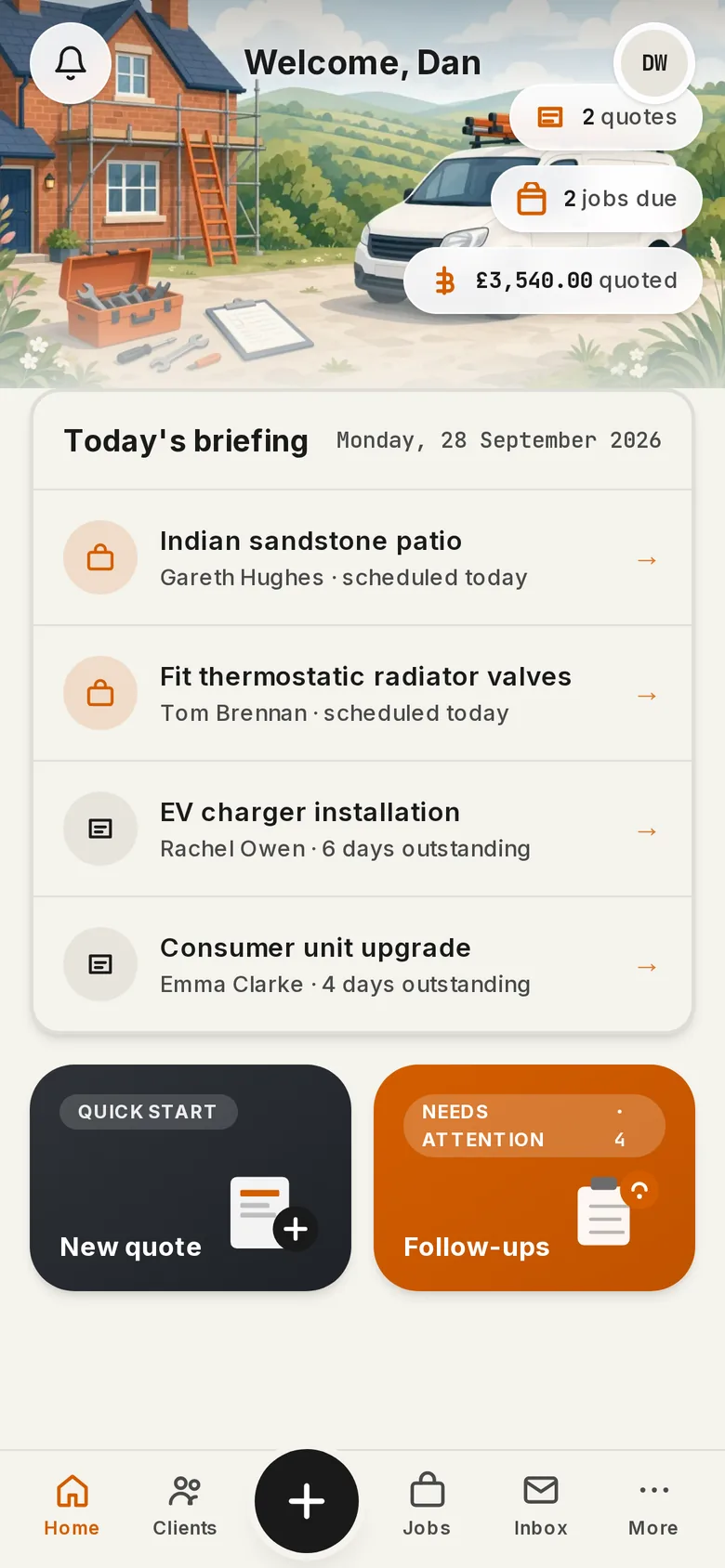
Filling this in by hand after a day on the tools is the part most people put off. With GraftMate you describe the job and AI drafts a professional quote in about two minutes. Download GraftMate on the App Store.
Worked example 1: electrician
The prices below are made up for illustration and are not a guide to what you should charge.
Quote Q-0142, consumer unit replacement, VAT-registered electrician
Description of work: Remove existing fuse board in under-stairs cupboard. Supply and fit one 10-way metal consumer unit with RCBOs and surge protection. Reconnect and label all existing circuits. Test and issue certificate on completion.
| Item | Price |
|---|---|
| Labour (one day) | £360.00 |
| Materials (consumer unit, RCBOs, surge protection, sundries) | £285.00 |
| Testing and certification | £75.00 |
| Subtotal | £720.00 |
| VAT at 20% | £144.00 |
| Total | £864.00 |
Not included: Repair of any existing circuit faults found during testing. These will be reported and quoted separately.
Terms: Quote valid for 30 days. Power will be off for most of the day. Balance due within 7 days of invoice.
This quote works because the exclusion deals with the most common dispute on a board change, which is faults on old circuits that only show up under test. More on quoting for electrical work is on our page for electricians.
Worked example 2: plumber
Quote Q-0087, toilet and basin tap replacement, plumber not VAT registered
Description of work: Remove and dispose of existing close-coupled toilet in first-floor bathroom. Supply and fit new close-coupled toilet with soft-close seat. Replace basin mixer tap and flexible connectors. Fit new isolation valves. Test for leaks.
| Item | Price |
|---|---|
| Labour (half day) | £240.00 |
| Materials (toilet, seat, mixer tap, valves, fittings) | £310.00 |
| Waste removal | £30.00 |
| Total | £580.00 |
Not VAT registered, so no VAT charged.
Not included: Flooring repairs, tiling or boxing in. Assumes: existing soil pipe and supply pipework are in sound condition and in the same position.
Terms: Quote valid for 30 days. Deposit of £174.00 (30%) on acceptance to cover materials. Balance of £406.00 due on completion.
The assumption line matters here. If the soil pipe turns out to be cracked, you have a clear basis for agreeing a variation. See our pages for plumbers and for heating and gas engineers for more trade-specific detail.
Validity and terms
How long should a quote be valid?
There is no set legal period, so you choose. Many trades use 30 days, because material prices move and your diary fills up. Always put an expiry date on the quote. Without one, a customer may come back months later expecting the old price.
Payment terms
State when you expect to be paid. GOV.UK says that unless you agree a payment date, the customer must pay within 30 days of getting your invoice or the goods or service. It also says you can set your own terms, including payment upfront. If you want paying on completion or within 7 days, write that on the quote.
Variations
Add a line saying extra work will be priced and agreed in writing before you do it. This matters most on bigger jobs, where the scope tends to grow. See our page for builders.
Cancellation rights when you sell in the customer's home
If a consumer agrees the contract with you in person away from your business premises, such as in their kitchen, it is likely to be an off-premises contract under the Consumer Contracts Regulations 2013. Three points matter for tradespeople:
- Cancellation period: for a service, the consumer can normally cancel within 14 days after the day the contract is entered into.
- Telling the customer: if you do not give the required cancellation information, the period can be extended by up to 12 months.
- Starting early: you should not start work inside the cancellation period unless the consumer expressly asks you to. For an off-premises contract that request must be in a durable form, such as email or on paper.
There are exceptions, so check how the rules apply to your work. This is general information and not legal advice.
Turning the quote into an invoice
When the job is done, the invoice should match the quote. GOV.UK lists what an invoice must include:
- a unique identification number
- your company name, address and contact information
- the customer's name and address
- a clear description of what you are charging for
- the supply date and the invoice date
- the amounts charged, VAT if applicable, and the total owed
Sole traders must also include their own name and any business name being used. If your quote already has all this, the invoice takes seconds. In GraftMate it is one tap. Try GraftMate.
Deposits
A deposit protects you against paying for materials on a job that then falls through. There is no fixed rule on how much to ask for. Keep it tied to something real, such as the cost of materials or special-order items, and state on the quote:
- the amount, or the percentage of the total
- when it is due
- what it covers
- what happens to it if the customer cancels
If you are VAT registered, a deposit is not outside VAT. HMRC's VAT Notice 700 says VAT is due on all deposits that are full or part payments for a supply of goods or services. The same applies to a payment you keep when a customer fails to take up the goods or service. Keep the consumer cancellation rights above in mind before you treat any deposit as non-refundable.
HMRC's published guidance is the limit of what this article covers on tax. Check with an accountant about your own VAT and tax position.
Common mistakes to avoid
- Vague descriptions. "Bathroom refit" invites a dispute. List what is being fitted and where.
- No exclusions. If you are not making good or decorating, say so.
- No expiry date. Always state how long the price holds.
- Unclear VAT. Say whether the price includes VAT, or that you are not registered.
- Verbal acceptance only. Get a signature, an email or a message saying "yes, go ahead".
- Slow quotes. A quote sent the same day shows the customer you are organised and keeps the job from going cold.
Send your next quote faster
Writing quotes is unpaid admin, but it is also how you win the work. GraftMate drafts the quote from your description of the job, turns it into an invoice in one tap, and keeps your clients, jobs and messages together. Download GraftMate on the App Store.
FAQs
Is a quote legally binding in the UK?
A quote is generally treated as a fixed price offer. Once the customer accepts it, you have a contract on those terms. Under the Consumer Rights Act 2015, what you tell a consumer about the service can become a binding term if they rely on it. If the job changes, agree a variation in writing before doing the extra work. For a specific dispute, get legal advice.
Do I need to put VAT on a quote?
If you are VAT registered, show the VAT and the total so the customer knows the full price. The standard rate is currently 20%. If you are not registered, do not add VAT, and state that on the quote. The registration threshold is £90,000 of taxable turnover. Check with an accountant if you are close to it.
How long should a quote be valid for?
There is no legal minimum or maximum. Thirty days is common, and you can go shorter when material prices are moving quickly. Put the expiry date on the quote.
Can I ask for a deposit before starting a job?
Yes. GOV.UK confirms you can set your own payment terms, including payment upfront. Put the amount, the due date and what it covers on the quote. If you are VAT registered, VAT is due on deposits that are part payment for the work.
Can I charge more than the quote?
Not for the work you quoted, unless the customer agrees. If you find extra work is needed, stop, explain it, price it and get agreement in writing before carrying on. Clear exclusions and assumptions on the original quote make that conversation much easier.
Should I give a quote or an estimate?
Give a quote when you can see and define the whole job. Give an estimate when you cannot, and say plainly that the final price may change. Label the document either way.
Try GraftMate on your next job
14-day free trial – no card needed
Cancel anytime · UK support