
Free template
CIS Invoice Template for UK Subcontractors

No iPhone? GraftMate works in the browser on any phone, including Android.
A CIS invoice is a normal UK invoice with a few extra details, so the contractor can verify you and take the right Construction Industry Scheme deduction. It needs your legal business name and Unique Taxpayer Reference (UTR), labour and materials shown as separate figures, the CIS deduction at 20%, 30% or 0%, and the amount actually due. If you and the contractor are both VAT registered, it usually also needs a VAT domestic reverse charge note. HMRC does not publish an official CIS invoice form. The template below combines what GOV.UK says every invoice must include with what a contractor needs to work out your deduction. Copy it, fill in the brackets and send it.
Copyable CIS invoice template
Copy the table into your own document, or use it as a checklist against the invoice you already send.
| Field | What to put |
|---|---|
| Invoice number | [Unique number, e.g. INV-0042] |
| Invoice date | [DD/MM/YYYY] |
| Date of supply | [Date or period the work was done] |
| Your name and business name | [Legal name or trading name, exactly as registered with HMRC] |
| Your address and contact details | [Address, phone, email] |
| Your UTR | [10-digit Unique Taxpayer Reference] |
| Company registration number | [Limited companies only] |
| Your VAT registration number | [If VAT registered] |
| Contractor name and address | [Who you are invoicing] |
| Contractor VAT registration number | [If the reverse charge applies] |
| Site or job reference | [Site address, order or job number] |
| Description of work | [Clear description of what you are charging for] |
| Labour | £[amount] |
| Materials you paid for directly | £[amount] |
| Other costs not subject to CIS (e.g. plant hire) | £[amount] |
| Net total (excluding VAT) | £[labour + materials + other] |
| VAT rate | [20%, 5% or not VAT registered] |
| VAT charged | £[amount, or £0.00 if the reverse charge applies] |
| Reverse charge note | [Reverse charge: Customer to pay the VAT to HMRC. VAT due at [rate]: £[amount]] |
| CIS deduction rate | [20%, 30% or 0%] |
| CIS deduction (on labour only) | −£[amount] |
| Total due | £[net total + VAT charged − CIS deduction] |
| Payment terms | [e.g. 14 days from invoice date] |
| Bank details | [Account name, sort code, account number] |
What each field is for
The details every UK invoice needs
GOV.UK sets out what every invoice must include:
- a unique identification number
- your company name, address and contact information
- the customer's company name and address
- a clear description of what you are charging for
- the date of supply and the date of the invoice
- the amounts charged, the VAT amount if applicable, and the total owed
Sole traders must also show their own name, any business name, and an address where legal documents can be delivered. Limited companies must use the full company name as it appears on the certificate of incorporation. The full list is in Invoices: what they must include.
Your UTR and legal business name
GOV.UK's general invoice rules do not ask for a UTR. It goes on a CIS invoice because the contractor has to verify you with HMRC before paying you. GOV.UK says to give your contractor your UTR and your legal business or trading name when you start work, so they can do this (get paid as a CIS subcontractor).
The contractor's details must exactly match what you used to register with HMRC. For a sole trader, the contractor verifies with your UTR and National Insurance number. For a limited company, it is the company name, company UTR and registration number (verify subcontractors). Putting the UTR on every invoice keeps the detail in front of whoever runs the contractor's payments.
Labour and materials split
If you send one lump-sum figure, the contractor cannot tell which part of it the deduction applies to. GOV.UK tells contractors to start with the gross amount of your invoice and take off:
- VAT
- materials you paid for directly
- equipment which is now unusable ("consumable stores")
- fuel used, except for travelling
- equipment hired for the job ("plant hire")
- manufacturing or prefabricating materials
The CIS rate is applied to what is left (make deductions and pay subcontractors). Show labour and materials on separate lines, and keep your receipts in case the contractor asks for evidence of the materials cost.
CIS deduction at 20%, 30% or 0%
The rate depends on your status with HMRC:
- 20% if you are registered for CIS.
- 30% if you are not registered, or the contractor cannot verify you.
- 0% if you have gross payment status. The contractor pays you in full and you settle your tax yourself.
The contractor passes the deduction to HMRC. GOV.UK describes these deductions as advance payments towards your tax and National Insurance bill (what you must do as a CIS subcontractor). The contractor confirms your rate when they verify you, so check with them if you are unsure which applies.
The VAT domestic reverse charge note
The reverse charge has applied to building and construction services since 1 March 2021. If it applies, you do not charge VAT on the invoice. Your customer accounts for it to HMRC instead.
According to HMRC's VAT domestic reverse charge technical guide, it applies when:
- your customer is registered for VAT in the UK
- the work is within the scope of CIS
- the supply is standard rated or reduced rated
- you are not an employment business
- your customer has not told you in writing that they are an end user or intermediary supplier
When it applies, your invoice must:
- show everything a VAT invoice normally shows
- include a note making clear that the reverse charge applies and the customer must account for the VAT
- state how much VAT is due under the reverse charge, or the rate if the amount cannot be shown
- leave that VAT out of the amount you charge
HMRC does not prescribe exact wording. Its examples include "Reverse charge: Customer to pay the VAT to HMRC" and "Reverse charge: VAT Act 1994 Section 55A applies" (HMRC manual VATREVCON37100).
Two more points from the technical guide:
- Materials: where they are supplied as part of the construction service, the reverse charge applies to the full value of the invoice.
- End users: if your customer has told you in writing that they are an end user or intermediary supplier, you charge VAT in the normal way.
If you are not VAT registered, leave the VAT lines and the reverse charge note off.
Want this laid out for you instead of typed by hand? Download GraftMate on the App Store.
Worked example with numbers
A CIS-registered bricklayer (20% rate) invoices a VAT-registered contractor for a week's work. Both are VAT registered, the contractor is not an end user, and the work is standard rated, so the reverse charge applies.
| Line | Amount |
|---|---|
| Labour | £1,000.00 |
| Materials paid for directly | £400.00 |
| Net total (excluding VAT) | £1,400.00 |
| VAT charged | £0.00 |
| Reverse charge: Customer to pay the VAT to HMRC. VAT due at 20% | £280.00 (not charged) |
| CIS deduction at 20% of £1,000 labour | −£200.00 |
| Total due | £1,200.00 |
The contractor pays £1,200 to the bricklayer and £200 to HMRC as the CIS deduction. The contractor also accounts for the £280 VAT on their own VAT return.
The same job at the other CIS rates:
| CIS status | Deduction on £1,000 labour | Total due |
|---|---|---|
| Registered (20%) | £200.00 | £1,200.00 |
| Not registered or not verified (30%) | £300.00 | £1,100.00 |
| Gross payment status (0%) | £0.00 | £1,400.00 |
If the reverse charge did not apply, for example because the customer confirmed in writing that they are an end user, the 20% invoice would charge £280 VAT. The CIS deduction is not taken from VAT, so it stays at £200 and the total due is £1,480.
How GraftMate does it in two minutes
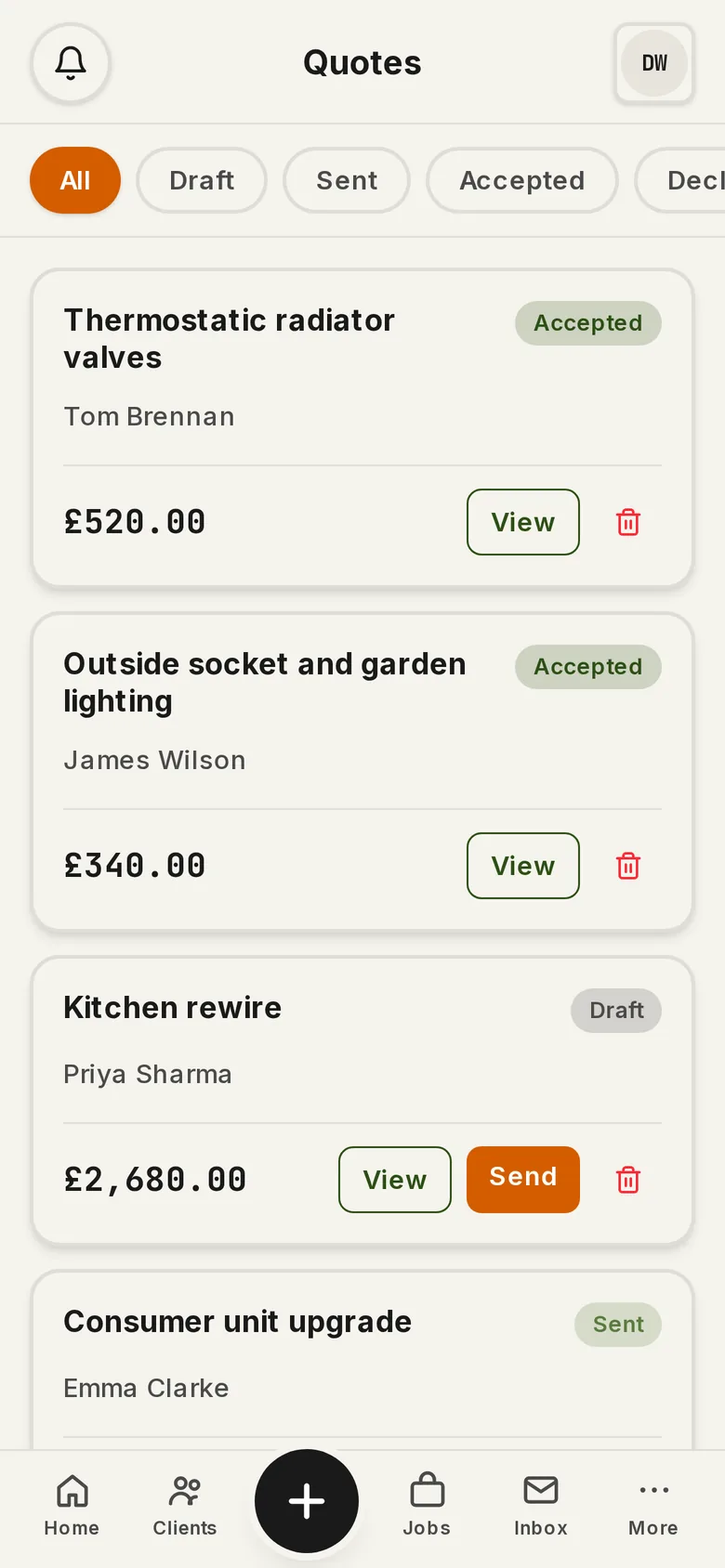
GraftMate is a UK iPhone and web app built for tradespeople. It takes the typing out of quoting and invoicing:
- Describe the job. Tell GraftMate what the work is in plain English, the way you would explain it to the customer.
- Get a drafted quote. AI turns your description into a professional quote in about two minutes. Read it over and change anything that is not right.
- Turn it into an invoice in one tap. When the job is done, the quote becomes an invoice without retyping it.
- Check it against the template. Before sending to a contractor, make sure the UTR, labour and materials split, CIS deduction and reverse charge note are all there.
- Keep it all together. Clients, jobs and messages sit in one place, so you are not hunting through texts and emails to find what was agreed.
Try GraftMate on your next job and see how long the paperwork takes.
Common mistakes on CIS invoices
- One lump-sum figure. With no labour and materials split, the contractor may apply the deduction to the whole amount.
- Name that does not match HMRC's records. If the contractor cannot verify you, the 30% rate applies.
- Charging VAT when the reverse charge applies. The VAT should be stated on the invoice but not included in the amount charged.
- No reverse charge wording. The invoice must make clear that the reverse charge applies.
- Taking the CIS deduction off the VAT-inclusive figure. The deduction is not taken from VAT.
- Not keeping statements. Your contractor must give you a payment and deduction statement within 14 days of the end of each tax month. Keep them, because they are your record of what has been paid to HMRC on your behalf.
A quick word on tax
This page sets out what HMRC publishes on GOV.UK and is not tax advice. CIS and VAT treatment depends on your own circumstances, so check with an accountant before you rely on it.
FAQs
Do I legally have to put my UTR on a CIS invoice?
GOV.UK's list of what an invoice must include does not mention the UTR. It does say to give your contractor your UTR and legal business or trading name so they can verify you. Putting it on the invoice is the practical way to keep that detail with every payment request, and many contractors ask for it.
Is the CIS deduction taken off materials?
No. GOV.UK says contractors take off the cost of materials you paid for directly before applying the CIS rate, along with VAT, plant hire and certain other costs. Show materials separately from labour on the invoice.
Is CIS deducted from VAT?
No. The contractor takes VAT off the gross amount before working out the deduction. If the reverse charge applies, you are not charging VAT on the invoice in the first place.
What wording should I use for the VAT reverse charge?
HMRC does not prescribe exact wording, but the invoice must make clear that the reverse charge applies. HMRC's examples include "Reverse charge: Customer to pay the VAT to HMRC" and "Reverse charge: VAT Act 1994 Section 55A applies". You also state the VAT amount or rate without adding it to the total.
What if I am not VAT registered?
Leave off the VAT lines and the reverse charge note. Your invoice still needs the standard invoice details, your UTR, the labour and materials split and the CIS deduction.
What if I have gross payment status?
The contractor pays you without making a deduction, so the CIS rate on your invoice is 0%. It is still sensible to show labour and materials separately.
Ready to stop building invoices by hand? Download GraftMate on the App Store.
Try GraftMate on your next job
14-day free trial – no card needed
Cancel anytime · UK support